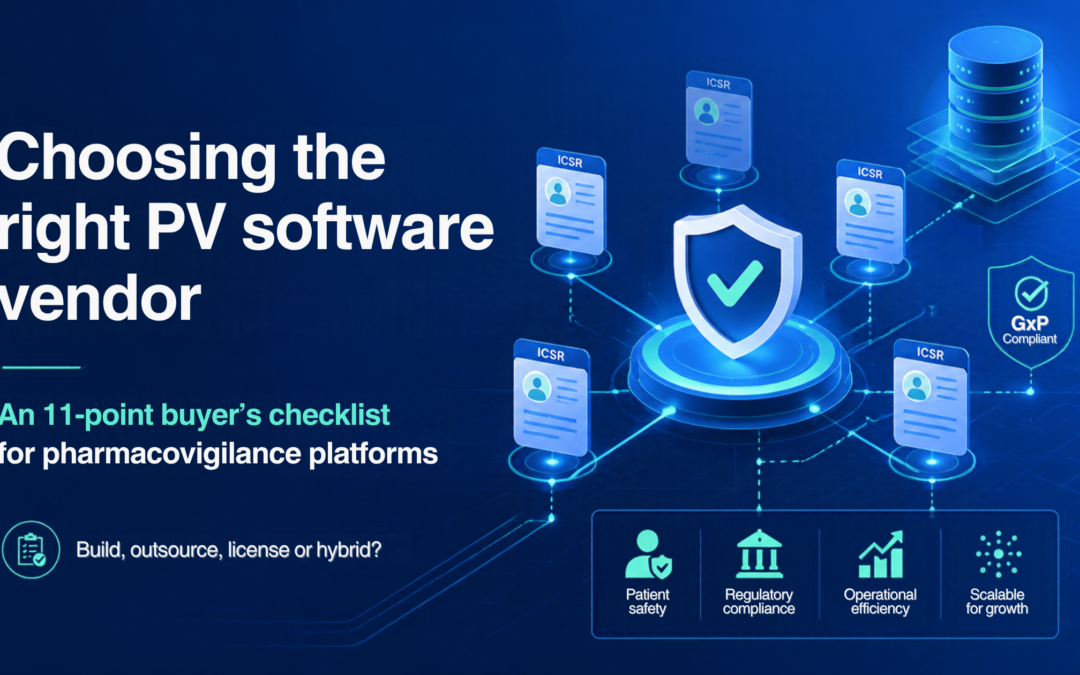
Choosing the right PV software vendor is a strategic decision. It affects patient safety, regulatory compliance, operational efficiency, and long‑term scalability.
Organisations can build in-house solutions, outsource PV operations, license commercial platforms, or adopt hybrid models. Each of these has distinct trade-offs in control, cost, time-to-live, validation burden, and global reporting capability.
This checklist outlines 11 essential criteria, from AE reporting, literature assessment, and ICSR processing to AI/automation, integration, reporting/analytics, usability, and compliance, to help you evaluate vendors systematically and select a PV platform that aligns with your company’s size, portfolio, and risk profile.
What is pharmacovigilance software?
Pharmacovigilance software is a tool used for detection, assessment, understanding, and prevention of ADRs (adverse drug reactions) or other drug-related problems. PV is particularly important for monitoring the safety profile of drugs throughout their life cycle.
It helps to minimise the risks associated with medications, contributes to patient safety, and provides pivotal data for regulatory decision-making. When it comes to pharmacovigilance software, the primary focus is on understanding the fundamentals of ICSRs, seriousness criteria, and reporting timelines. It is also important to develop a working knowledge of MedDRA terminology and to familiarise yourself with key regulatory concepts and reporting requirements from agencies such as the EMA and FDA. This helps identify how adverse reactions can sometimes occur due to drug combinations rather than single drug intake.
What does pharmacovigilance software do?
PV software is also referred to as the drug safety database or PV database. It helps pharmaceutical companies, contract research organisations (CROs), and marketing authorisation holders (MAHs) manage drug safety activities throughout a medicine’s lifetime.
It is far more complex, as it deals with dirtier data from more patients than there are trial participants. At its core, pharmacovigilance software implements these tasks:
- Detect and manage adverse event reports (ICSRs)
- Code medical information
- Ensure regulatory compliance
- Enable signal detection and risk management
- Maintain compliance and audit readiness
Make or Buy: Build, outsource, or licence?
When you are looking to adopt pharmacovigilance software in your workflow, there are three models.
They are:
- Building in-house solutions
- Outsource PV solutions
- Licensing a ready-made PV platform
Building in-house solutions
Off-the-shelf PV software often fails to meet in-house requirements. When you tailor an in-house solution, you enhance compliance and accelerate data-driven decision-making. Developing an in-house solution allows you to strengthen the tool’s robustness and ensure it is inspection-ready.
When you develop bespoke pharmacovigilance software, you can automate repetitive tasks, integrate medical, regulatory, and quality systems, and enhance data accuracy. This enables you to achieve insights more quickly with AI and improve collaboration and accuracy.
Building a PV platform in-house gives you maximum control over workflows, data architecture, integrations, and customization.
Outsource PV solutions
As per your firm’s requirements, you can outsource adverse event intake, case management, literature assessment, ICSR processing, signal detection, aggregate reporting, case intake, or quality control rather than managing everything internally.
This approach provides access to specialized PV firms, reduces internal resource requirements, and is useful if you lack advanced PV infrastructure.
With outsourcing, you can also strengthen inspection readiness. When auditors or inspectors raise questions, the outsourced team needs to know what they are doing and why. This asserts that you are a seasoned firm outsourcing services to a honed PV firm.
Licensing a ready-made PV platform
Licensing can be a game-changer for smaller companies, especially in the pharma and life sciences sectors. It lets you access innovation, markets, and capabilities without investing massive capital or risking building everything in-house. Licensing is particularly significant if you want to go live within months, not years. If you operate in multiple geographical regions and need proven E2B(R3) with submission capability, licensing is also beneficial.
Let’s understand why licensing is powerful for smaller companies:
If you are a small firm, there are three bottlenecks you may be facing: limited capital, narrow operational bandwidth, and high development/regulatory risk. Licensing helps address these challenges by:
- Capital efficiency: Licensing helps reduce the cost of full R&D, clinical trials, and global commercialisation on its own.
- Risk sharing: The partner shares development, regulatory, and market risks.
- Quick roll-out: Licensing shortens timelines by leveraging existing IP, data, and sometimes even regulatory approvals, which is critical when competitors are moving fast.
- Non-dilutive funding: Upfront fees, milestones, and royalties provide cash flow without giving up equity which is vital for startups and small teams.
Pharma-ai.de provides operational support with licensing for regulatory, commercialisation, and tech integration, enabling small teams to focus on core R&D or niche differentiation. AI-enabled pharmacovigilance automation (L2AI for EudraVigilance L2A ICSR processing) reduces manual workload and cost while meeting strict compliance requirements. Small companies
| Option | Best suited for | Advantages | Main disadvantages |
| Build in-house | Large pharma, software companies, and highly specialised workflows. | Maximum control, custom workflows, ownership of data and IP, deep integration with internal systems. | High validation burden, long time-to-market, continuous maintenance, expensive regulatory updates, and difficult global reporting support. |
| Outsource operations | Small- and mid-sized pharma and biotech companies with fluctuating case volumes. | Access to trained case processors, medical reviewers, literature surveillance, aggregate reporting, and established procedures. | Vendor oversight remains necessary due to data and process dependency, variable quality, and transition risk. |
| License commercial software. | Most established pharma, biotech, CROs, and growing MAHs. | Faster deployment, mature workflows, regulatory reporting, audit trails, dictionaries, integrations, and vendor product updates are all key benefits. | Subscription/license cost, configuration complexity, implementation effort, and vendor lock-in. |
| License plus outsource | Startups, virtual pharma, regional MAHs, and companies that launch products quickly. | Fastest operational readiness with lower internal headcount. | Requires strong governance, quality agreements, vendor qualification, and internal PV ownership. |
11 Essential Buyer’s Checklist Points for PV Software
These are 11 checklist points that a pharmacovigilance software must have in order to remain compliant:
-
Literature Assessment
AI-driven literature assessment connects directly to PubMed and Embase via APIs. It automatically classifies articles as ICSR-relevant, PSUR/signal-relevant, or invalid using a curated keyword library.
It also detects duplicates across publications and generates E2B(R3) XML files for direct ingestion into the safety database. So, while you are looking for PV software, a literature assessment is an integral part of the process.
-
Signal Detection and Risk Management
PV has evolved seamlessly recently. While it was once a reactive discipline, it has grown into a proactive, data-driven science. At its core lie signal detection and risk management. These two are interconnected processes that have become fundamental to ensuring patient safety while balancing benefits and potential harms.
Your PV software should help with routine signal detection activities, document findings, apply statistical tools, and ensure the adequacy of detection systems.
-
Ensure Compliance with Key Regulations
Pharmaceutical and life sciences industries are continually expanding and seeking seamless ways to do so. When you are dabbling in pharmacovigilance software for your firm, you must follow regulatory guidelines. Here, regulatory authorities such as the EMA, FDA, and TGA issue guidelines for pharmacovigilance.
-
ICSR Case Processing
The Individual Case Safety Report (ICSR) process is a critical component of pharmacovigilance, enabling the effective detection, assessment, and management of adverse drug reactions. A well-structured and efficient ICSR management process supports drug safety and facilitates timely reporting.
Without rigorous case processing, safety data becomes unreliable. Here, an ICSR serves as a detailed report of suspected adverse reactions. It is imperative that your PV software includes ICSRs to identify potential safety concerns and take pivotal actions.
-
AI & Automation Features
AI is disrupting pharmacovigilance at a nimble pace. It provides unprecedented efficiency, predictive insights, and scalability. When your PV software includes AI, its algorithms can automatically extract information from ADRs, the literature, and electronic health records, considerably reducing manual case entry and review times.
It can forecast potential safety issues, thus mitigating risks before they escalate. Therefore, AI is an integral part of your PV software.
-
Safety Database & Scalability
Effective management of ICSRs in pharmacovigilance is essential for protecting patient safety and maintaining regulatory compliance.
A dedicated safety database enables pharmacovigilance teams to capture, process, manage, and analyze safety data more efficiently and securely than spreadsheets or other non-computerized systems. By centralizing safety information and supporting standardized workflows, a safety database improves data accuracy, traceability, and timeliness across pharmacovigilance operations.
-
Integration Capabilities
To ensure seamless integration, pharmacovigilance software should support standardized APIs such as REST and SOAP; global data exchange formats including XML, ICH E2B(R3), and HL7; and robust middleware. These capabilities enable smooth and reliable connectivity with clinical, regulatory, safety, and electronic health record (EHR) systems.
-
Reporting and Analytics
Reporting and analytics turn raw safety data into actionable insights, enabling timely signal detection, proactive risk management, and data-driven decision-making across PV operations.
They provide real-time visibility into case-processing performance, regulatory-timeline compliance, and quality metrics, which are critical for inspection readiness and continuous improvement. Advanced analytics, including AI-enabled signal detection and trend analysis, further enhance early warning capabilities and strategic safety oversight.
-
User Friendliness
An intuitive interface and ease of operation streamline ADR processes. This guides users through data entry fields, ensuring holistic accuracy in reporting.
Your pharmacovigilance software should be user-friendly because poor usability directly increases processing time and leads to errors. It poses a training burden, which can compromise data quality, regulatory compliance, and ultimately patient safety.
Intuitive, role-based interfaces with streamlined workflows reduce clicks and manual steps. This enables faster case intake, coding, review, and reporting while freeing PV scientists to focus on higher-value tasks like signal assessment and benefit–risk evaluation.
-
MedDRA and WHO-DD Integration
Consistent coding is the underlying factor of every safety activity. If two coders review the same event differently, signal detection degrades. Therefore, a PV system should incorporate the current MedDRA event dictionary and the WHO Drug Dictionary for medicinal products, with integrated browsing, auto-suggestion, and version control.
-
Adverse Event (AE) Reporting
Adverse event reporting is the cornerstone of the pharmaceutical industry. At its heart, pharmacovigilance exists to protect patient safety by complying with regulatory requirements. However, for a PV program to operate effectively, it is crucial to promptly identify adverse events. This is why, when looking for pharmacovigilance software, it is imperative to ensure that the tool can identify adverse reactions. It is the core engine for drug safety, protecting patients’ health and ensuring compliance with regulatory bodies such as the EMA and the FDA.
EudraVigilance Screening with L2AI
L2AI is a software solution designed to automate the processing of high volumes of EudraVigilance L2A Individual Case Safety Reports (ICSRs). By leveraging advanced analytics, including machine learning and active learning, L2AI continuously refines its performance, enabling organizations to improve the quality of analysis and achieve up to 50% cost savings compared with traditional manual approaches.
The platform supports end-to-end automated ICSR processing. It automatically downloads L2A reports from EudraVigilance. The tool performs comprehensive analysis and evaluation, applies necessary modifications and coding, and uploads the processed cases back to the gateway, while handling duplicate and follow-up detection. Because L2AI learns from each new L2A ICSR, it can robustly handle adverse reaction reports in multiple languages and cope with synonyms, abbreviations, and spelling variations, applying these learnings to enhance the accuracy and efficiency of all future cases.
If you are looking for a solution that processes EudraVigilance L2A ICSR, L2AI is the best-fit tool.
Book a FREE DEMO of L2AI now and let’s take it further.